
Marcus W. Clarke is the mind and maker behind All Glory, Laud, and Honor, an Exhibition Proposal Series show. You can find him at an artist panel on Christianity in Contemporary Art on the show’s closing day, October 4. This interview has been lightly edited for length and clarity.
Can you tell us a little about yourself?
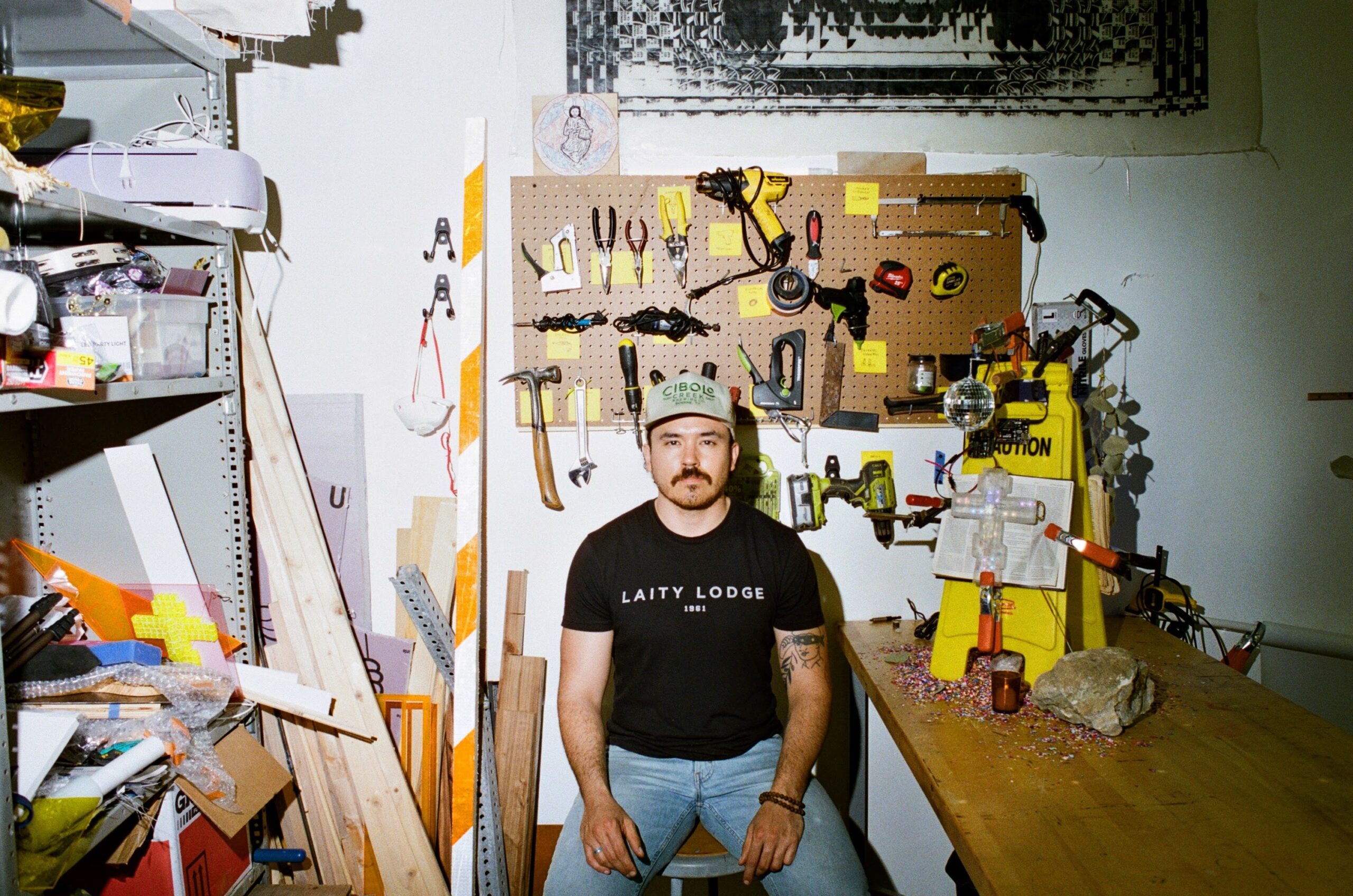
My name is Marcus. I teach sculpture and installation art at College of the Holy Cross in Worcester. I’m originally from central Texas – sort of bopped between Austin and San Antonio for a while – and grew up in a small town where my folks still are.
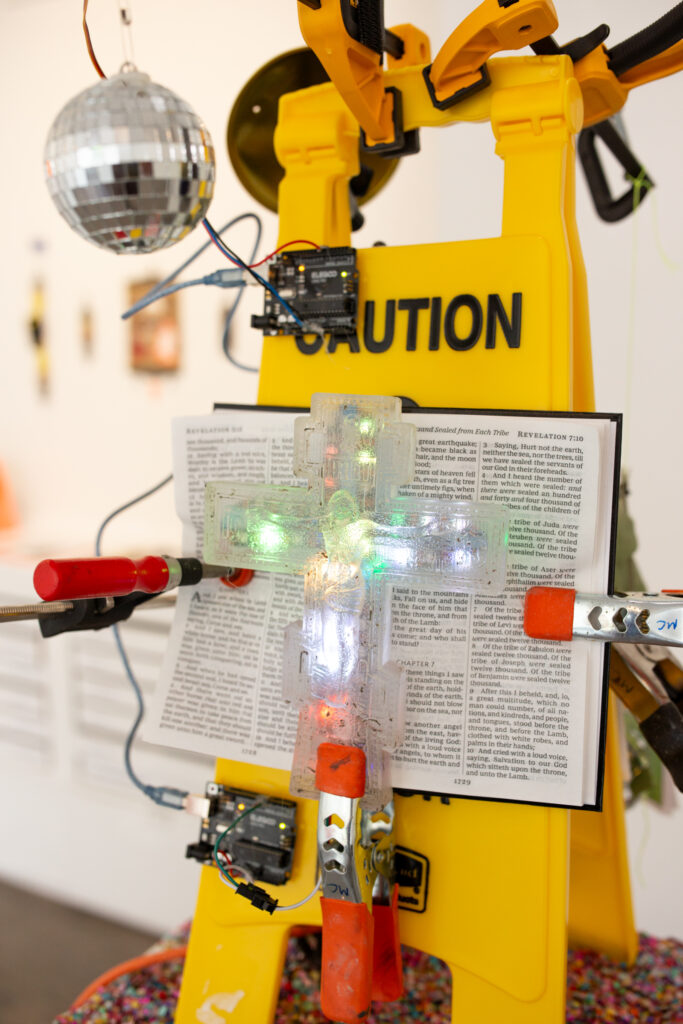
I primarily consider my practice to be in sculpture installations and new media. Technology ends up a lot in my art, but not for the purposes of making commentary on technology. Usually most of my art is about religion, specifically American Christianity and the ways that it plays out.
I’m interested in how there’s a lot of subsets of American Christianity that require blind belief and investigating some of the neuroticism, perhaps, or lack of logic or critical thinking behind those. But also, there’s something really childlike and desirable about that, which I’m also attracted to. It’s this realm that I’m kind of captivated in. And I would call myself a believer, but I have a lot of doubts, so I try to bring those to the table.
Why is it important for you to question the things you just mentioned? And why craft All, Glory, Laud, and Honor at this moment?
It’s funny because I feel like I’ve been making art in this sort of vein for the last decade, but, man, it just becomes more and more relevant, especially from a political standpoint. There are a lot of things occurring politically that happen in the name of Christianity.
I grew up in central Texas, but in a very, progressive family. In our political alignings, we’re sort of alienated within our small town. When I was a teenager and looked at Christianity more seriously and thought of becoming a believer for lack of a better term, I never considered my politics to be at odds with my desire for transcendence or spirituality. Especially with the words of Jesus that I was seeing in the Bible, that didn’t seem at odds with my liberalism.
So I find a profound amount of dissonance between the ways that Christianity is used as propaganda and militarized by right-wing politicians. And that feels like it’s increasing more and more with the second Trump administration and the ways that Christianity gets polluted and co-opted into politics in really gross ways.
Can you speak on the materials you use and why?
One of my pieces, Icon and Censer, is a clear epoxy mold of my hand holding an orthodox censer, which is like an incense bowl. It has bells on it, too, all attached to a mechanical oscillating motor powered by a motion sensor. When people are far away from the work, it’s static. When people approach the work, the motor starts turning and the bells start clanging; the epoxy hand has LED lights in it, it starts strobing.
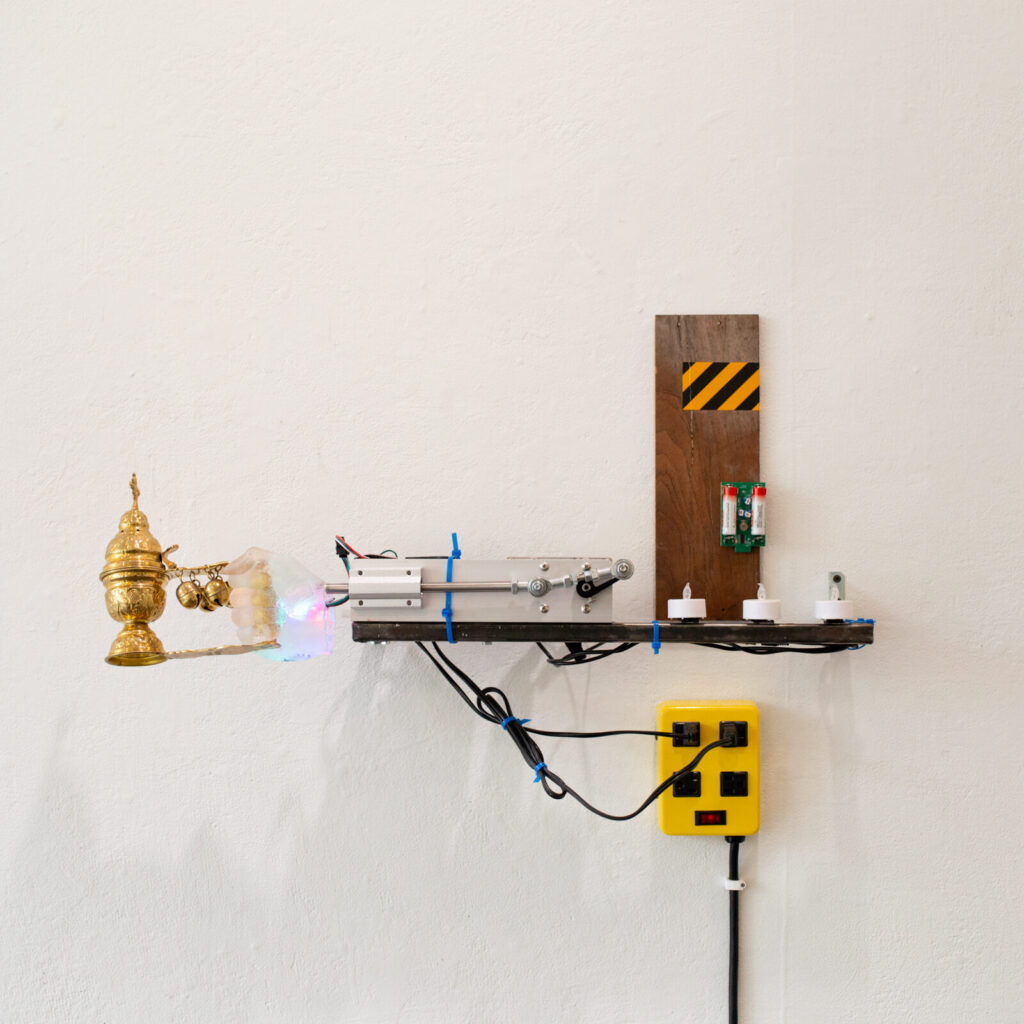
It’s almost like this object is one that is seeing you and perceiving you, then in an automated way, is demanding your attention. With the loud bells and the strobe lights, I’m thinking of our attention economy. A lot of modern Christian movements, like mega churches, are deploying tactics of the attention economy to successful degrees to get people in the doors. That piece uses automation, almost a stand-in for a nefarious force, whether that be a mega church pastor that runs more like a business or a spiritual force perhaps. I’m open to interpretation. When people think about the attention economy, I don’t know that the values of Christianity come to mind, but they are so entrenched.
Where do you make your work? With the recent move, perhaps studio space is in-progress.
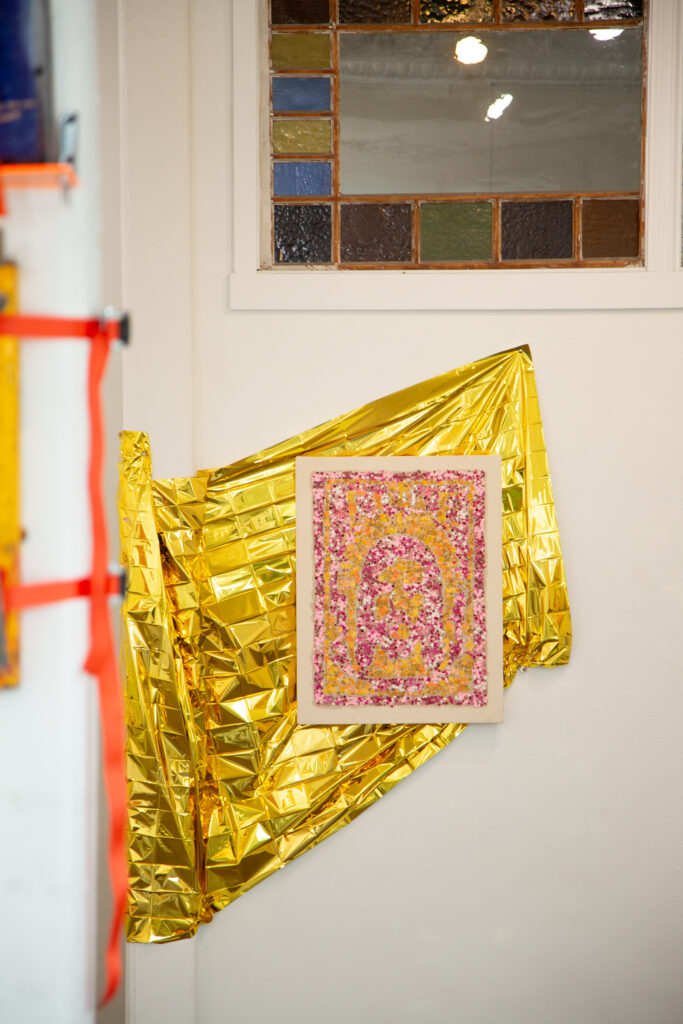
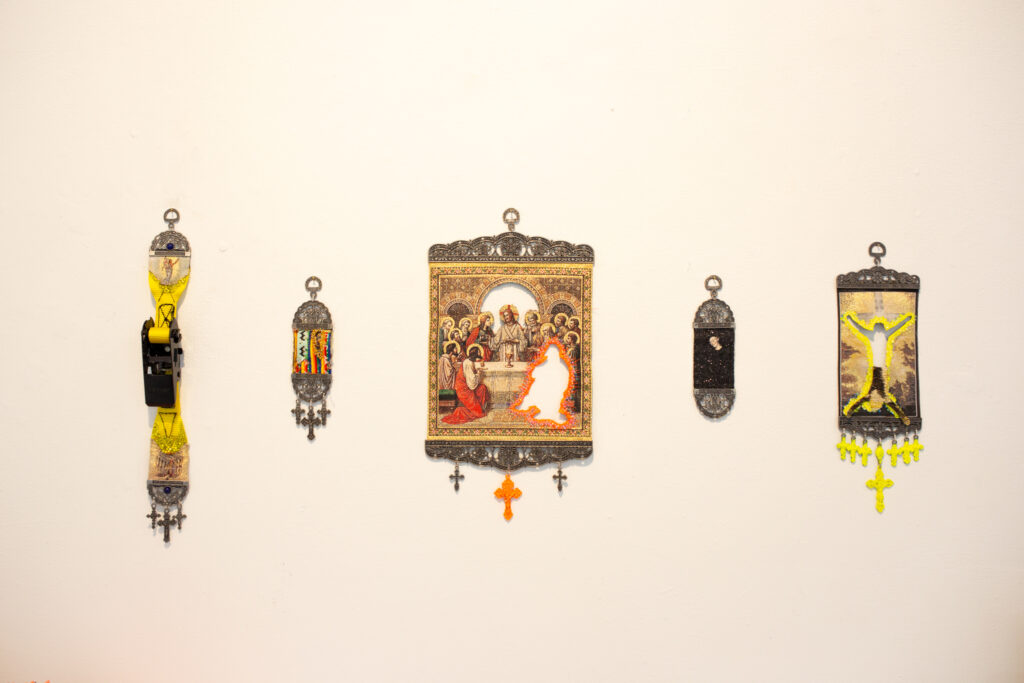
Oh man, rent is so expensive here. I wasn’t prepared for it. A lot of the work that I have in the show I made during graduate school in San Antonio, when I had a lot of studio space. Currently I’m making a lot of work in my apartment, which is a 300 square foot studio, but I’ve allocated a lot of the space in there to art making. I’ll make paintings, and I’ve been working recently on altering some jacquard tapestries that I get off eBay that are Catholic or Orthodox, probably from someone’s grandmother. Those have felt really good, one because my studio restrictions right now are kind of forcing me to work smaller, which isn’t something I usually do, but I’ve also been really fascinated with that medium and sewing lately. Just kind of slowing down and doing something ritualistic and rhythmic. But then I’m also using, to contrast it, heavy-duty hardware.
There’s one piece where I took an icon, cut it in half, and then sewed both of those halves to ratchet straps. You have this huge juxtaposition between this really gentle, honestly stunning, tiny icon, and then it’s sewn to heavy-duty, completely utilitarian ratchet straps that someone could get from the Home Depot. There’s a dissonance in the materiality, versus this icon that’s pictorially representing something.
Are there particular contemporary artists, maybe fabric artists, inspiring you?
There was an artist that did a talk while I was in grad school, Justin Korver. He was working in jacquard, and I think that’s when thoughts came up to use textiles … I think jacquard also comes up because WWJD (What Would Jesus Do) bracelets, popular during the 90s, also use the process. For a while I was trying to juxtapose those bracelets – a product of consumerist Christianity, performativity and posturing – with sculptures. Nothing actually panned out with it, but I still have 50 of them in my car.
Were there pivotal places, people or experiences that encouraged you to pursue this practice?
I feel strongly about the work that I make because it’s such a unique realm. I don’t think religion gets talked about very much in the gallery. But the course of contemporary art is very anti-institution for good reason.
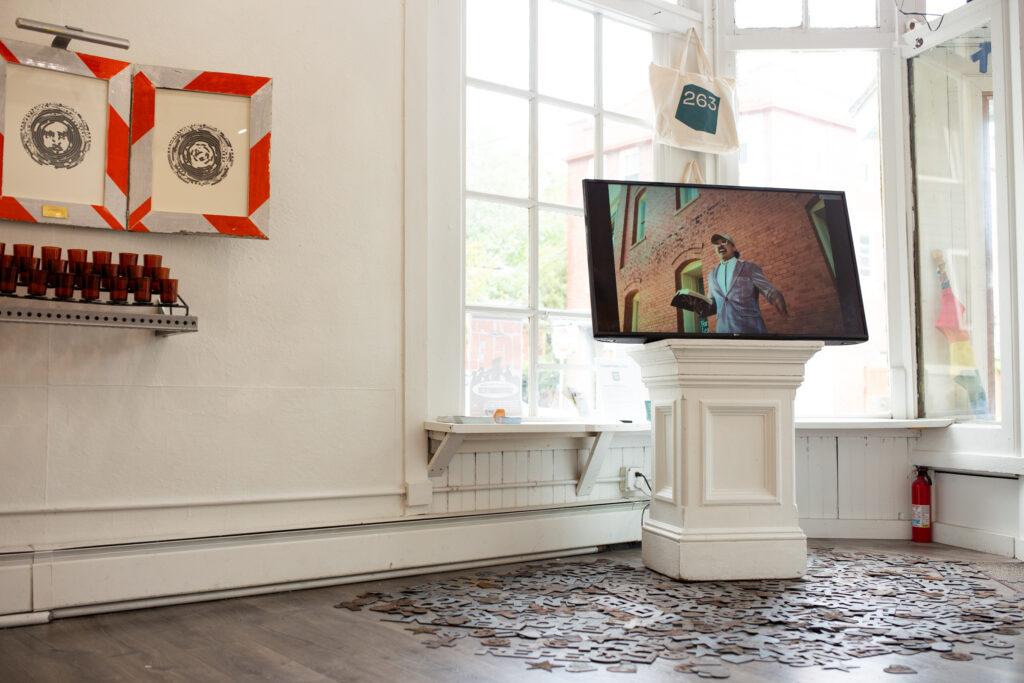
During my first graduate review, I got obliterated by my professors for trying to talk about Christianity. I had another professor trying to back me up, which caused infighting. After that, I went and took a visiting students course at Duke Divinity School in contemporary art and theology – I think that’s where my eyes were opened to having religious objects malfunction, and asking cultural and theological questions that oscillate between the critical and the sincere.
Andres Serrano and his Piss Christ is the first piece that comes to mind. In that piece, a crucifix is submerged in a couple of gallons of Serrano’s piss. There’s actually something really theologically meaningful to it. The crucifix is an object that we’re so anesthetized to, it’s so common. All the classrooms at our Catholic school, Holy Cross, have a crucifix above the door – this depiction of a naked man being murdered and tortured in the most painful way imaginable. It is a super gory object, and so, what would be a better way to recontextualize the violence and the embarrassment of that than putting it in a vat of piss? Piss Christ is my north star.
What are you looking forward to after this exhibition?
I’m a visiting professor here at Holy Cross, so my time will be done there in May, and I’ll be moving on to the next professorship that I get, wherever that is. I am eager to be in New England for the winter so I can snowboard. I’m also excited for the ways my work will continue to evolve.
I graduated in May, and there’s a statistic that five years after grad school, it’s pretty normal for 4 out of 5 artists to stop their practice. Halfway through, I was like, yeah, that’s gonna be me. I’m so sick of this. But the show that I had in May, which a lot of this work is coming from, was the first I had maybe ever that I was like, yeah, I’m like excited to continue this body of work still. The tapestries that I’ve been playing with this summer have been a great example of that. Most of my work happens listening to jazz music at like 10:30 p.m. on a Friday night while drinking beer. I can’t tell you what’s next.
Anything else on your mind that you’d like to share?
If people want to learn more about the interesting moment that Christianity is having, especially within Gen Z, there’s a new book out by Lamorna Ash. She set out to do a cultural anthropology of Christianity in Great Britain when two of her friends from college, who were stand-up comedians, decided to convert to Catholicism and discern whether or not they’re gonna become celibate priests.
Along the way she starts having her own sort of conversion experience, but in a very particular way as a queer person. It’s called Don’t Forget We’re Here Forever, a very humble, honest cultural anthropology of Christianity, which is hard to come by because I feel like most people doing that work belong to theological institutions and might have a little bit too much emotional stake invested. Sometimes I feel like my own work has a little bit too much and I have to check myself. Her perspective is very sober and it’s really excellent.